

Automated Stock Trading Software That Executes
Most traders do not lose because their ideas are poor. They lose because execution breaks down. The entry comes late, the exit gets moved, the setup is skipped, or the trade is managed emotionally. Automated stock trading software exists to remove that weak point. It takes defined logic and turns it into consistent action, so your edge does not depend on whether you are watching the screen at the right moment.
That sounds simple, but the gap between a script and a system that can survive live markets is where most platforms fall short. If you trade actively across stocks, crypto, indices, forex or commodities, the real question is not whether automation works. It is whether your software can translate strategy into fast, reliable execution without forcing you into a fragmented workflow.
What automated stock trading software should actually do
At a basic level, automated stock trading software monitors price, checks conditions, and places trades without manual input. But serious traders need more than a rule engine. They need a full path from idea to validation to deployment.
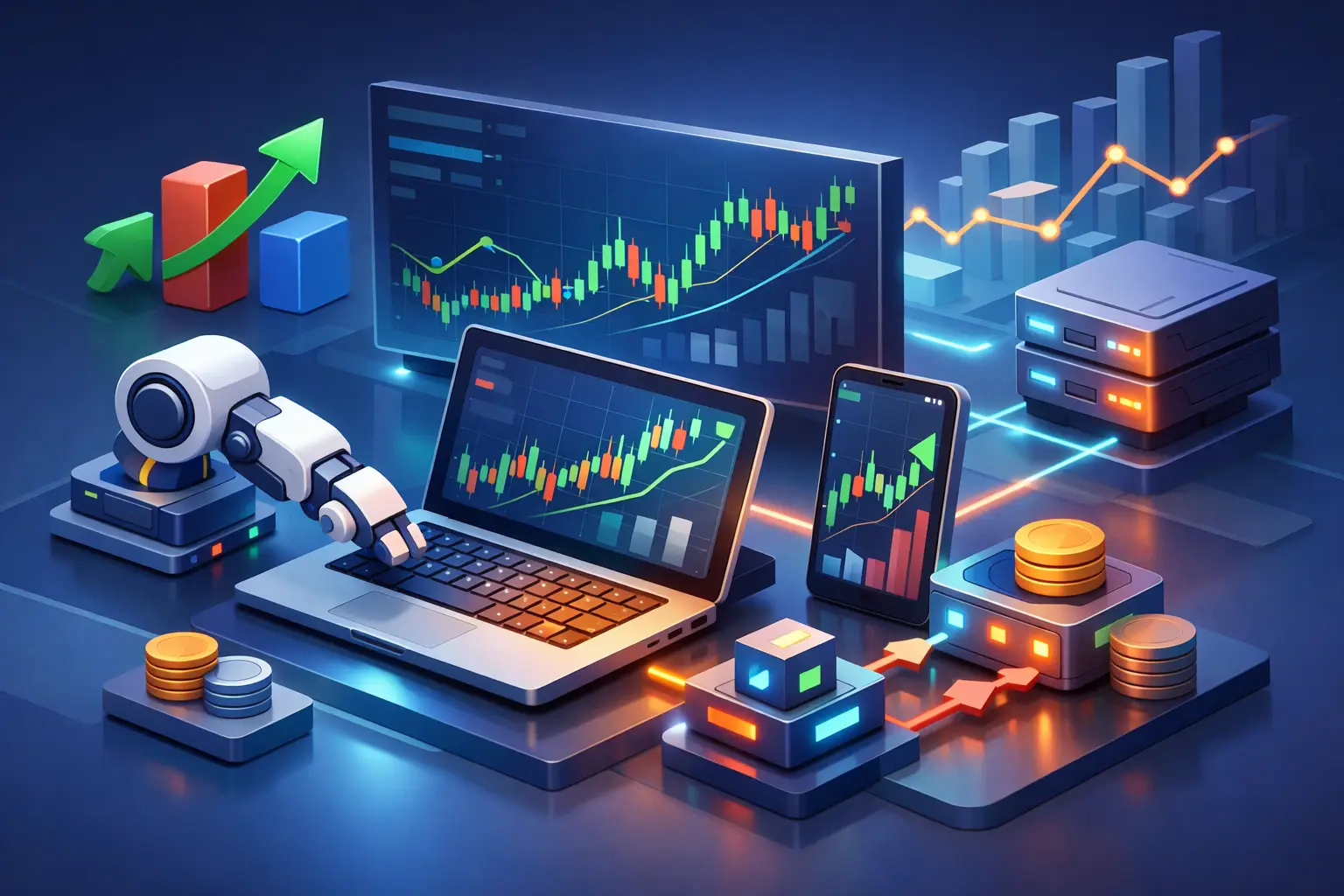
That means charting where you can inspect setups visually, strategy logic that matches how you think, historical testing on relevant market data, live execution with minimal delay, and monitoring once the strategy is running. If any part of that chain is weak, the system becomes harder to trust.
This is why many traders get stuck. They build signals in one tool, test in another, execute somewhere else, and then manage risk manually through a separate interface. Each hand-off adds friction. Each delay creates room for error. Automation is supposed to reduce complexity, not move it around.
Why manual trading stops scaling
Manual trading can work when you are running one market, one timeframe, and a limited number of setups. The problem appears when opportunity expands faster than your attention. A good strategy on paper becomes impossible to execute perfectly across multiple instruments and sessions.
Markets do not wait for you to finish dinner, wake up, or stop second-guessing. If your edge depends on reacting quickly to repeatable conditions, then manual execution introduces noise into something that should be systematic. You are no longer testing your strategy. You are testing your stamina, discipline and screen time.
Automated execution changes that. It lets you define the conditions once and apply them repeatedly. That does not guarantee profit. It does mean the result is more likely to reflect the logic of the strategy rather than the inconsistency of the trader.
The difference between basic automation and real trading infrastructure
A lot of software claims to automate trading. Some of it simply sends alerts. Some of it can place orders, but only through clumsy workarounds. Some tools are fine for experimentation, yet too fragile for serious capital.
The difference comes down to infrastructure. Good automation is not just about writing rules. It is about what happens when those rules meet live markets. Can the platform handle fast conditions? Can it execute with low latency? Can it stay online continuously? Can you monitor signals and positions in real time without jumping between windows?
This matters even more if you trade beyond a single asset class. Many traders today do not think in silos. They may run a momentum strategy on tokenised stocks, mean reversion on crypto, and macro-driven setups on indices or metals. In that environment, your software needs to support breadth without sacrificing speed.
How to judge automated stock trading software
The best way to assess a platform is to follow the actual trading workflow.
1. Strategy building
You need flexibility at the logic layer. For some traders that means code. For others it means adapting indicators and conditions visually. Either way, the software should let you express precise rules, not vague approximations.
Look for support that matches how strategies are really developed. If you already work with chart-based logic and indicator scripting, native compatibility matters. It shortens the distance between analysis and execution.
2. Backtesting
Backtesting should not be treated as a marketing feature. It is where bad ideas are exposed before they cost money. The key is relevance. Historical data needs to reflect the market you intend to trade, and test conditions need to be close enough to reality to make the results useful.
No backtest is perfect. Slippage, market regime shifts and execution conditions can all change outcomes. But a proper test still gives you something essential - evidence. It tells you whether the strategy has structure, not just story.
3. Deployment
This is where many traders discover the platform is not as automated as advertised. Live deployment should be direct. If turning on a strategy requires multiple connectors, external servers, or a chain of third-party tools, the risk of failure rises quickly.
Clean deployment matters because automated systems only deliver value when they can run continuously. The goal is straightforward: define the logic, validate it, launch it, and let it execute without constant intervention.
4. Live control
Automation does not mean blindness. Once a strategy is live, you still need visibility. Real-time signal visualisation, position tracking, order status and performance monitoring are part of the job. You are removing manual execution, not giving up oversight.
The strongest platforms keep this close to the chart and execution layer, so you can understand what the system is doing at a glance and step in if market conditions change beyond the strategy’s design.
Where traders usually make mistakes
The first mistake is automating too early. If you cannot explain exactly why a strategy should work, coding it will not fix the problem. Automation amplifies discipline, but it also amplifies bad logic.
The second mistake is trusting attractive backtests without questioning market context. A strategy may perform well in one regime and fail in another. Trend systems can suffer in chop. Mean reversion can get steamrolled in expansion. Good software helps you test. Good judgement decides whether the result is durable.
The third mistake is underestimating execution quality. A strategy with a small statistical edge can be wrecked by slow fills, downtime or poor order handling. For active traders, infrastructure is part of the strategy.
Why on-chain execution is becoming harder to ignore
Traditional brokerage automation often comes with familiar compromises: opaque routing, restricted access, platform lock-in, and very little transparency around what happens beneath the interface. Traders have learned to accept that because there were few alternatives with serious speed.
That is changing. On-chain trading infrastructure has improved enough that automation is no longer limited to slow, experimental environments. With the right execution layer, traders can run autonomous systems directly on high-performance markets while keeping transparency and control.
That shift matters because it aligns the software with the trader’s incentives. You are not just getting a front end for placing orders. You are getting a direct path from strategy to execution on open infrastructure, without handing control to a centralised venue that can change the rules around you.
For traders who want one environment for charting, backtesting, deployment and monitoring, this is where platforms like Borsa stand out. Instead of splitting analysis from execution, the workflow stays unified and on-chain, with the speed needed for active systematic trading across multiple markets.
The real standard: less friction, more edge
If you are evaluating automated stock trading software, ignore the glossy promises and focus on one question: does it make your edge easier to express and harder to disrupt?
The right platform should let you move from idea to test to live execution without rebuilding the strategy at each step. It should support the way you already analyse markets. It should keep running when you are offline. And it should give you enough visibility to trust the system without micromanaging it.
Automation is not about removing the trader from the process. It is about removing hesitation, inconsistency and operational drag. The human still decides what deserves capital. The software handles the repetition.
That is the real value. Not more charts. Not more indicators. Not more noise. Just cleaner execution of a proven idea, at speed, across the markets you actually trade.
Build a system worth trusting, then let it do the work.